How to Price Handmade Beaded Wristlets and Keychains
A sustainable price for a handmade beaded wristlet or keychain should cover materials, labor, overhead, selling fees and profit. Add those costs first, then compare the result with similar products. Do not begin with a competitor’s price and work backward by quietly removing your own pay.
A practical starting formula is: materials + labor + overhead + fixed selling fees + profit, adjusted for any percentage-based selling fees. This separates the cost of making the item from the money the business earns after paying for that work.
Start with the true material cost
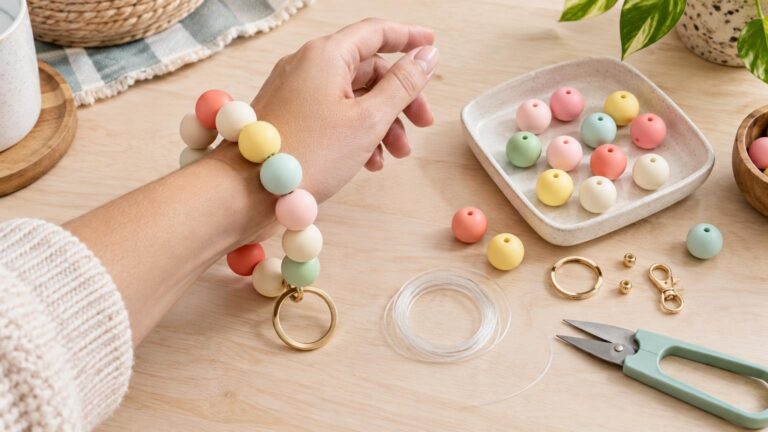
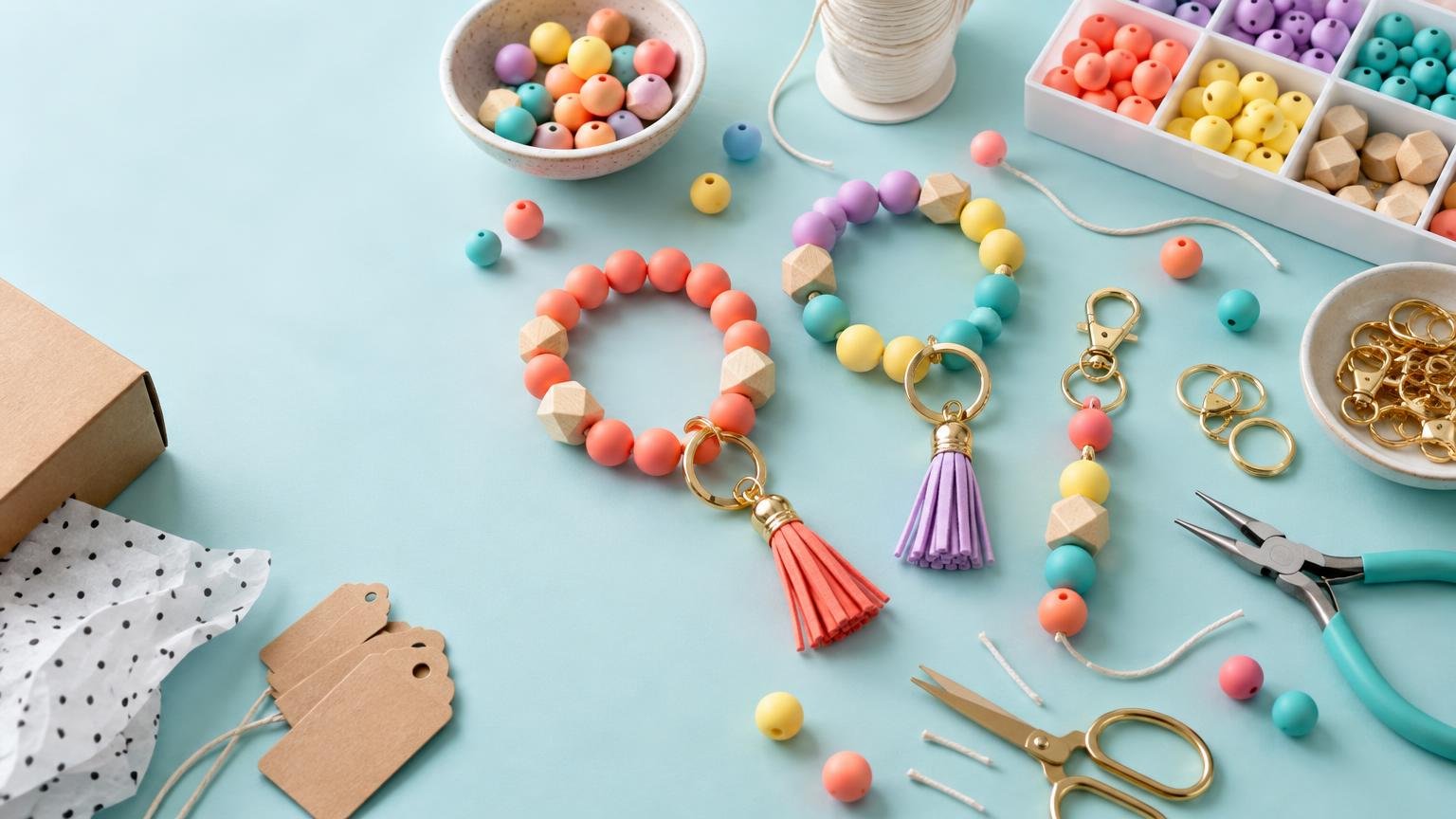
List every component used in one finished wristlet or keychain. That usually includes beads, cord, a clasp or split ring, accent hardware, charms, tassels, packaging and a small allowance for waste. If you buy supplies in bulk, calculate the per-piece or per-inch cost rather than entering the full package price.
Component choices can change the total more than they appear to at the craft table. Current supplier examples include 12 mm silicone beads at $19.99 per 100, 15 mm beads at $23.99 per 100, 2 mm satin nylon cord with a breakaway clasp at $0.85 per yard and one-inch split rings at $27.23 per 1,000. Those prices are snapshots rather than universal rates, but they show why bead size, cord usage, hardware and order quantity should be recorded separately.
For example, a 15 mm bead costing about $0.24 contributes roughly $3.36 to a 14-bead design before cord, hardware or packaging. If you are still refining the design, use the guidance on estimating how many beads a wristlet needs, then confirm the count on the exact cord and focal-bead combination you intend to sell.
Include waste instead of pretending every supply becomes a sellable item. Cord tails, rejected beads, spilled findings and occasional remakes are normal production costs. A simple approach is to add a small percentage to consumable materials or record actual waste over several batches and use the resulting average.
Pay for all of your working time
Labor is more than threading beads. It can include selecting colors, laying out a pattern, personalizing a name, assembling and finishing the piece, checking the knot or closure, packaging the order and cleaning the workspace. Custom orders may also require messages, mockups and approval time.
Choose an hourly labor rate, time the complete process and convert the result into a per-item cost. At an $18 hourly rate, 20 minutes of work costs $6. If a personalized wristlet takes another 10 minutes of design and communication, that adds $3. The figures are examples; your rate should reflect your goals, local circumstances and the skill involved.
Time a small batch rather than relying on your fastest assembly. Divide the total working time by the number of sale-ready pieces. This captures ordinary interruptions and finishing work while preventing one unusually slow first attempt from setting every future price.
Give overhead and packaging their own lines
Overhead covers business expenses that do not fit neatly into one wristlet: tools, storage bins, work surfaces, lighting, printer supplies, photography equipment, software and market-display materials. Estimate a monthly amount and divide it by a realistic number of items sold, or assign a modest per-item allowance and review it as the business grows.
Packaging belongs in the calculation even when it costs less than the beads. Boxes, inserts, care cards, bags, labels and mailers can turn into a substantial cost across a batch. Build the actual stack first using a plan such as packaging handmade beaded wristlets, and then calculate the cost of that complete stack. If you add branded labels, account for both the sticker and any design or setup expense; small-format artwork should also be checked on the real package before ordering a large quantity.
Add profit after labor, not instead of it
Labor pays for the time spent completing the order. Profit is what remains for growth, new designs, equipment replacement, discounts and business risk. Treating profit as your labor pay makes it difficult to tell whether the product itself is financially worthwhile.
You can use a fixed dollar profit per item or a percentage markup, but apply the method consistently. A fixed amount is easy for a focused product line. A percentage can scale more naturally when premium components increase the money tied up in each piece.
Use a cost sheet to find the base price
The following example is an illustrative cost sheet for one beaded wristlet. Replace every number with your own invoices, timed labor and packaging choices.
| Cost category | Example amount | What it covers |
|---|---|---|
| Beads | $3.36 | Fourteen beads at $0.24 each |
| Cord and waste | $0.45 | Used cord, trimming and a waste allowance |
| Hardware | $0.80 | Ring, clasp or connector |
| Packaging | $0.90 | Bag or box, insert and label |
| Labor | $6.00 | Twenty minutes at $18 per hour |
| Overhead | $1.25 | Allocated tools, storage and operating costs |
| Target profit | $3.00 | Money retained beyond labor and expenses |
| Base direct-sale price | $15.76 | Total before channel-specific fees |
In this example, $15.76 is the minimum calculated direct-sale price before any payment, marketplace or event fees. A seller might choose a clean retail price above that figure, such as $16 or $17, but rounding should go up rather than erase a cost line.
Adjust the formula for marketplace fees
Marketplace pricing needs a separate calculation because some fees are percentages of the order total. Etsy currently lists a US$0.20 listing fee and a 6.5% transaction fee on the total order amount, including shipping and gift wrap. Etsy Payments processing is additional and varies by country, with both a percentage and a fixed component. Check the current Etsy fee schedule for the location where your shop operates.
To preserve your intended labor pay and profit, use this formula when percentage fees apply: list price = (non-percentage costs + intended profit + fixed fees) ÷ (1 − combined percentage fee rate).
Suppose the example wristlet has $15.76 in costs and intended profit, $0.45 in combined fixed fees, and an illustrative combined percentage rate of 9.5%. The calculation is $16.21 ÷ 0.905, producing a minimum list price of about $17.91. This is a model, not a statement of the payment rate for your shop; insert the current fees that apply to your country, payment method and selling channel.
Run the same exercise for craft fairs, wholesale orders and direct sales. An event may have no percentage fee but still require booth rent, travel, display materials and card-processing costs. Wholesale should not automatically mean cutting the retail price in half. Offer a lower unit price only when larger quantities genuinely reduce packaging, communication, setup or assembly time per piece.
Use comparable products as a check, not the formula
After calculating your price, compare it with products that use similar materials, dimensions, hardware, personalization and packaging. Etsy’s pricing guidance for sellers recommends accounting for materials, labor, overhead and profit, while using comparable listings as a market check. It also notes that a maker does not have to be the cheapest when craftsmanship, design or materials differ meaningfully.
If your calculated price is much higher than similar items, investigate the difference instead of immediately lowering it. You may be buying beads in expensive quantities, spending too long on a complicated finish or using premium packaging on a basic product. Alternatively, the design may need clearer photos and descriptions so buyers can see the upgraded hardware, careful finishing or customization included.
Create tiers that reflect real differences
Pricing tiers make sense when the inputs or workload genuinely change. Keep the distinctions easy for a buyer to understand.
- Basic: a repeating bead pattern, standard hardware and simple packaging.
- Personalized: a name, custom palette or design approval that adds beads, planning and customer communication.
- Premium: specialty focal beads, upgraded hardware, a charm or tassel, more detailed finishing or gift-ready packaging.
Calculate each tier independently. Do not add an arbitrary personalization surcharge if letter selection and customer messages consistently take 15 extra minutes. Price that time directly, along with any extra components and remake risk.
Keep child-directed products out of casual guesswork
Small beads and detachable components require special attention if a wristlet or keychain is marketed for children. The U.S. Consumer Product Safety Commission considers stated intent, advertising and whether consumers commonly recognize an item as being for children. Components may also be evaluated to determine whether they detach during use-and-abuse testing. Review the CPSC small-parts guidance before describing or marketing a product for children.
An adult accessory or general handmade gift should not be represented as a toy, teether or safety-tested children’s product without product-specific support. Pricing cannot compensate for an unsuitable design or an unsupported safety claim. Decide the intended user and product description before choosing components, packaging or sales language.
Build a price you can repeat
The cleanest next step is to make one master cost sheet for each design. Record the bead count, cord length, hardware, packaging, average waste, timed labor, overhead allowance, channel fees and target profit. Recalculate when a supplier price, package, design or selling channel changes.
Your final price should let you remake the item, pay for the time involved and still retain profit. If it cannot do those three things, the answer is not simply to charge less. Simplify the design, buy appropriate components in better quantities, improve the workflow or position the wristlet in a tier that honestly reflects the work.
References
- Wholesale Silicone – USA Silicone Bead Supply Princess Bead Supply
- 2mm Satin Nylon Cord & Break-Away Clasps – USA Silicone Bead Supply Princess Bead Supply
- Wholesale Key Rings | Bulk-Buy Key Rings | Elite Supplies Plus
- Etsy Fee Basics – Etsy Help
- What are the Fees and Taxes for Selling on Etsy? – Etsy Help
- Pricing Basics: How to Price for Profit, Conversion, and Growth
- Small Parts and Choking Hazard Labeling FAQs | CPSC.gov